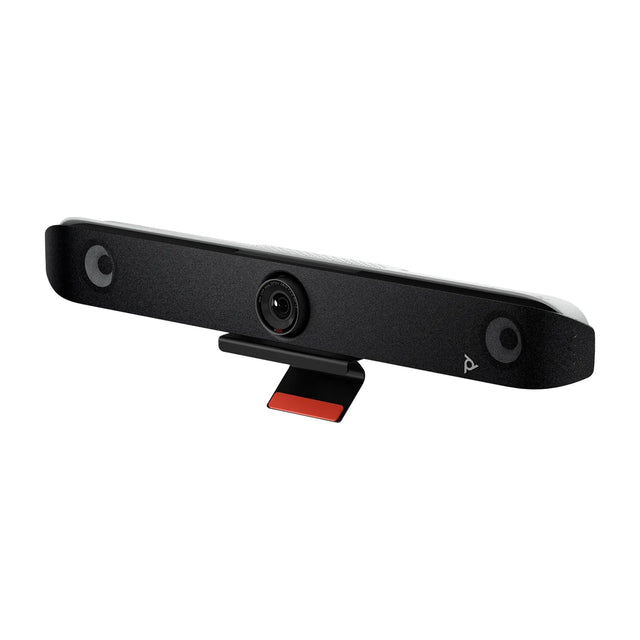
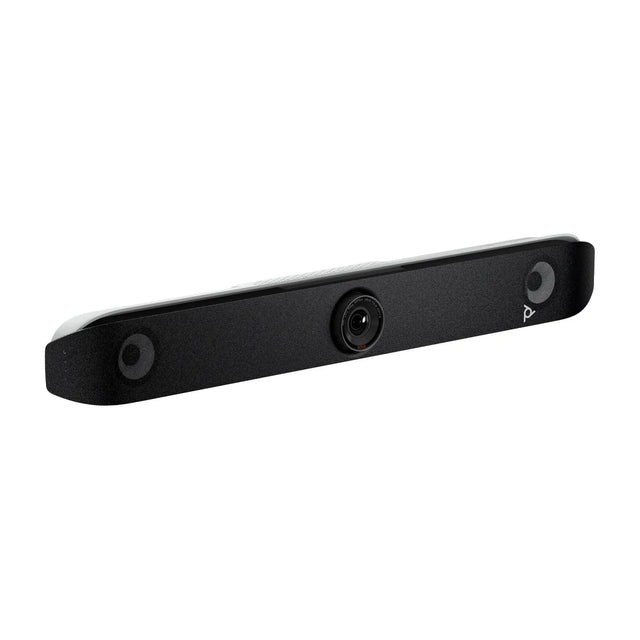
A video conferencing codec is the part of a video system that compresses and decompresses audio and video so it can travel over a network. "Codec" also means the device that does that work: the box that connects the room's camera, microphones and display and runs the call. In modern rooms the codec is usually built into a video bar or is a small compute unit, such as the Poly G7500 or a Teams Rooms PC.

Two meanings of "codec"
| Meaning | What it is | Examples |
|---|---|---|
| Compression standard | The algorithm that encodes video and audio | H.264, H.265/HEVC, VP8, VP9, AV1 for video; Opus, G.722 and others for audio |
| Codec device | The hardware that runs the call and connects room peripherals | Poly G7500, Poly Studio G62, Teams Rooms compute, Logitech RoomMate |
When an AV integrator talks about "the codec," they mean the device.
What a codec device does
- Takes video from the camera(s) and audio from the microphones.
- Encodes them and sends them over the network to the meeting service.
- Decodes incoming video and audio and sends them to the display and speakers.
- Handles echo cancellation, content sharing, layouts and the user interface on the touch controller.
- Runs the meeting software itself: Teams Rooms, Zoom Rooms, Google Meet, or a SIP/H.323 client on traditional systems.
Hardware vs software codecs
Twenty years ago, codecs were dedicated appliances from Polycom, Tandberg, Cisco and LifeSize. They dialed each other directly over SIP or H.323. Today most meetings run on cloud platforms, and the "codec" is software running on general-purpose hardware.
| Type | How it works | Pros | Cons |
|---|---|---|---|
| Traditional hardware codec | Purpose-built appliance using SIP/H.323 | Standards-based dialing, very stable | Needs bridges or interop services to join Teams/Zoom |
| PC-based (software) | Windows PC or Mac running Teams Rooms or Zoom Rooms | Flexible, many USB peripherals | More parts to manage |
| Android appliance | Compute built into a video bar or small box | Simple, one device, managed by the platform | Fixed peripherals on all-in-one bars |
Where the codec lives in today's rooms
- All-in-one video bars like the Poly Studio X52, Logitech Rally Bar and Neat Bar Generation 2 have the codec inside. The bar is the camera, mics, speaker and computer.
- Modular codecs like the Poly G7500 and Poly Studio G62 sit behind the display and connect separate cameras and microphones, for large and custom rooms.
- Teams Rooms on Windows compute such as the Poly Studio 5 Room Compute or Studio 7 Room Compute runs Teams with USB cameras and audio.
- Logitech RoomMate (product) adds appliance compute to USB devices like Rally Plus or MeetUp.
- USB bars in BYOD mode have no codec at all. The laptop does the encoding.
Do you still need a dedicated codec?
Only in some cases:
- Large or custom rooms with several cameras, ceiling mics and DSPs: a modular codec or Windows compute makes sense.
- SIP/H.323 interop: if you still call legacy room systems directly, you need a device or service that supports those protocols. Teams Rooms Pro can join SIP-capable meetings with a SIP dialing plan; see joining Zoom or Meet from Teams Rooms.
- Standard rooms up to about 20 seats: an all-in-one bar is usually simpler and cheaper.
For background on the full system, read how video conferencing works and video conferencing vs telepresence.
Replacing an old Polycom or Cisco codec? Tell us what's in the room and we'll suggest a modern replacement.
Related guides
Outfitting several rooms, or reselling? Get a volume quote or apply for wholesale pricing →